Most people can tell you roughly what they earn. Very few can tell you where it goes. That gap, between the money you think you spend and the money you actually spend, is the single most expensive blind spot in personal finance. A spending tracker closes it.
If you have ever reached the end of the month wondering how the account balance got so low, this guide is for you. We will cover what a spending tracker is, how it differs from a budget, how to track spending by category without burning out, and how getFlourish turns that tracking into insight you can act on.
What Is a Spending Tracker?
A spending tracker is a simple system that records what you actually spend and sorts it into categories, so you can see where your money really goes. Groceries, dining, gas, shopping, self care, transit: each purchase gets logged against a category, and the totals reveal the truth about your habits.
Here is the key distinction that trips people up. Expense tracking is observation. Budgeting is planning. A budget records where you want your money to go. A spending tracker records where it went. The two are not the same, and the most useful money system combines both: a planned amount for each category, sitting right next to what you actually spent, so the gap is impossible to ignore.
That gap is where the value lives. It is one thing to say "I spend too much on takeout." It is another to see "I planned $300 for dining and spent $470, and here is exactly where the extra $170 went." The first is a vague feeling. The second is a decision waiting to be made.
Why Tracking Spending Actually Works
Research on financial behavior keeps landing on the same finding: people who track their spending, even without a strict budget, tend to spend less than people who do not track at all. The act of observing changes the behavior. When you know a purchase has to be logged and categorized, you pause. That small moment of friction is often enough to talk yourself out of the impulse buy.
This is why a spending tracker is one of the highest leverage habits in all of personal finance. You are not depriving yourself. You are not following a rigid set of rules someone else invented. You are simply paying attention, and attention alone moves the needle.
But awareness without structure has a failure mode. Plenty of people know they overspend on dining or shopping, feel guilty about it, and change nothing. Knowing is not the same as changing. The missing piece is a target to measure against and a system that makes the overspend visible in real time, while you still have the month left to course correct. That is the difference between a spending tracker that just makes you feel bad and one that actually helps.
How to Track Spending by Category
Categories are the engine of a good spending tracker. Without them, you have a pile of transactions. With them, you have a map. Here is how to set them up so they actually work for your life.
Start With Broad Categories, Not Granular Ones
A common mistake is creating forty hyper-specific categories on day one. Coffee, then lunch, then dinner, then snacks, then groceries, all separated out. It feels thorough. It is actually a trap, because the more categories you have, the more decisions each purchase requires, and the faster you quit.
Start broad. Most people need only a handful of variable spending categories to capture the vast majority of their discretionary money:
- Grocery. Food you buy to prepare at home.
- Dining. Restaurants, takeout, coffee, delivery.
- Gas or transit. However you get around.
- Shopping. Clothing, household goods, the miscellaneous stuff.
- Self care. Haircuts, gym, personal spending.
You can always split a category later once you see it is a problem area. But you cannot stick with a system that demands too much effort per transaction. Simplicity is what keeps you tracking in month three, and month three is where the real insights show up.
Separate Fixed Costs From Variable Spending
Not everything belongs in a spending tracker. Your rent does not change based on your behavior this month. Neither does your phone bill or your car insurance. These are fixed costs, and while they belong in your overall budget, they are not where a spending tracker earns its keep.
The magic of category tracking happens with variable spending: the flexible, day to day money that swings based on the choices you make. That is where the leaks are. That is where a hundred dollars vanishes without a single memorable purchase. Focus your tracking energy there, and let your fixed costs sit quietly in the budget where they belong.
Log Actual Against Planned
This is the step that turns a tracker into a tool. For each category, set a planned amount, then log what you actually spend as the month unfolds. A good spending tracker shows you three numbers at a glance: what you planned, what you have spent so far, and what is left.
Spent $200 of your $400 grocery budget by the fifteenth? You are on pace. Spent $340 of it? You have a decision to make with two weeks still to go. That real time feedback loop is the entire point. It is far more powerful than reviewing a bank statement at the end of the month, when the money is already gone and all you can do is feel regret.
Handle the Unexpected Expenses
Real life does not respect your categories. A parking ticket, a vet visit, a birthday gift you forgot about: these unexpected expenses are exactly the things that blow up an otherwise disciplined month, and most trackers have no clean place to put them.
Inside getFlourish, you can add an unexpected expense directly in the Spending Tracker, assign it to a category, and choose whether it comes out of Paycheck 1 or Paycheck 2. It flows straight into your variable spending and your totals, so a surprise cost gets captured instead of quietly wrecking your numbers. Accounting for the unexpected is what separates a tracker you trust from one you abandon the first time life throws a curveball.
The 50/30/20 Lens
If you want a framework to sanity check your category spending against, the 50/30/20 rule is the most popular starting point, and for good reason. It divides your after tax income into three buckets: 50 percent for needs, 30 percent for wants, and 20 percent for savings and debt payoff beyond the minimums.
Your spending tracker maps neatly onto this. Groceries, gas, and transit are mostly needs. Dining, shopping, and self care are mostly wants. When you track by category, you can roll those categories up into needs versus wants and see whether your actual behavior matches the plan.
A quick honest note for anyone in a high cost city: the classic percentages bend under real rent. If housing eats 40 to 50 percent of your take home pay on its own, a pure 50/30/20 split is not realistic, and that is fine. Use it as a compass, not a cage. The point is not to hit the exact numbers. The point is to know your numbers at all, which is precisely what a spending tracker gives you.
How getFlourish Handles Spending Tracking
getFlourish was built around the idea that tracking should be effortless enough to actually maintain and insightful enough to be worth it. Here is how the Spending Tracker works.
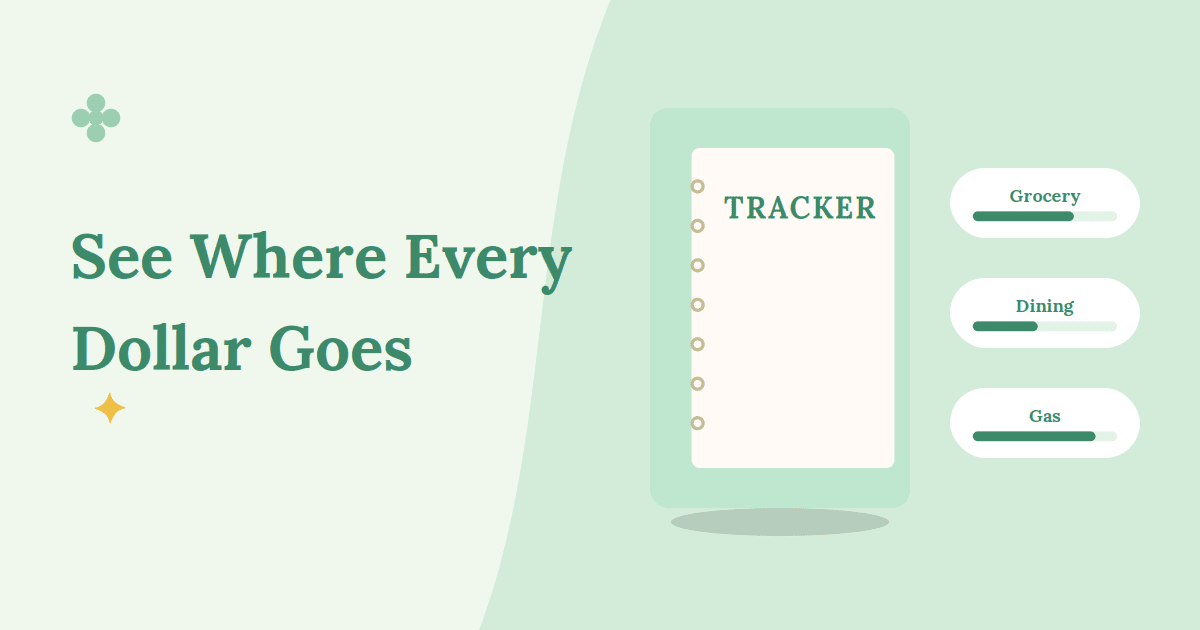
Every variable category you set up shows as its own card, with a progress bar that fills as you spend. The bar stays green while you are comfortably under budget, shifts to amber as you approach your limit, and turns red when you go over, with a clear alert so you never blow past a category without noticing. You see what you spent, what you budgeted, and exactly how much is left, all in one glance.
At the top, two running totals show your spent this month and your remaining variable budget, with an overall progress bar for the whole month. Because getFlourish is built around paycheck cycles, your spending is organized across Paycheck 1 and Paycheck 2, which matches how your money actually arrives if you are paid biweekly. And when something unexpected comes up, you add it on the spot and assign it to the right paycheck, so nothing slips through the cracks.
All of this feeds your wider plan automatically. The money you log in the Spending Tracker flows into your monthly totals, your Budget Health Score, and your year overview, so the small act of logging a coffee quietly improves the accuracy of your entire financial picture. You track once, and the insight shows up everywhere.
Building the Habit That Sticks
The best spending tracker is the one you still use in ninety days. Here is how to get there.
Log little and often rather than in one dreaded weekly session. Thirty seconds after a purchase beats twenty minutes on a Sunday you will eventually skip. Keep your categories few. Forgive yourself for a missed day and just pick it back up, because a tracker with a few gaps is infinitely more useful than a perfect one you quit. And review your numbers at the end of each month, not to judge yourself, but to ask one question: where did the gap between planned and actual show up, and what is one small change worth making next month?
That is the whole game. Observe, notice the gap, adjust by a little, repeat. Do that for a few months and you will not just have cleaner numbers. You will have a genuinely different relationship with your money, built not on restriction but on clarity.
The Bottom Line
A spending tracker does not require willpower or deprivation. It requires attention, and attention is the one thing that reliably changes how money behaves. Set up a handful of categories, track what you actually spend against what you planned, account for the unexpected, and let the gap between the two guide your decisions. Do that consistently, and the mystery of where your money goes disappears for good.
Frequently Asked Questions
What is the difference between a spending tracker and a budget? A budget is a plan for where your money should go. A spending tracker is a record of where it actually went. The most effective system uses both together: you set a planned amount for each category, then log your actual spending against it, so you can see the gap in real time and adjust while the month is still in progress.
How do I track my spending by category? Start with a small set of broad variable categories such as grocery, dining, gas, shopping, and self care. Set a planned amount for each, then log what you spend as it happens. Keep the categories few so logging stays quick, and focus on variable spending rather than fixed costs like rent, since that is where your choices actually move the numbers.
How many spending categories should I have? Fewer than you think. Most people capture the majority of their discretionary spending with five to eight variable categories. Too many categories makes every purchase a decision and is the fastest way to abandon tracking altogether. Start broad, and only split a category out later once you can see it is a genuine problem area.
Does tracking my spending actually help me save money? Yes. Studies of financial behavior consistently find that people who track their spending tend to spend less than people who do not, even without a strict budget. The act of logging and categorizing a purchase creates a moment of awareness that often prevents impulse spending. Awareness alone changes behavior, and a good tracker turns that awareness into specific, actionable decisions.
How do I handle unexpected expenses in a spending tracker? Give them a home instead of letting them float. In getFlourish, you can add an unexpected expense directly in the Spending Tracker, assign it a category, and choose whether it comes out of Paycheck 1 or Paycheck 2. It flows into your variable spending and totals automatically, so a surprise cost gets captured rather than quietly derailing your month.
What is the easiest way to start tracking spending in Canada? Use a tool built around how you actually get paid. getFlourish organizes your spending into paycheck cycles and variable categories, shows planned versus actual for each one, and updates your totals and Budget Health Score as you go. You can start with a free trial, set up your categories in minutes, and begin tracking the same day.