What Paying Only the Minimum Actually Costs You
Paying only the minimum keeps a credit card account in good standing, nothing more. On a typical $5,000 balance at a standard Canadian card rate, minimum payments alone can stretch repayment past 20 years and cost more in interest than the amount you originally borrowed, because the minimum shrinks every month right along with the balance.
Most people know minimum payments are expensive in some vague sense. Few have actually seen the number, because the math is not something a bank statement spells out in plain language. It is worth seeing once, because the mechanics of why it takes so long are more specific, and more fixable, than "interest adds up."
How Your Minimum Payment Is Actually Calculated
Outside Quebec, most Canadian card issuers set your minimum payment at 2% to 3% of your outstanding balance, or $10, whichever is higher, with interest and fees added on top (BDO Debt Solutions). Quebec sets a higher legal floor: provincial rules require a minimum of at least 5% of the balance, roughly double the typical rate elsewhere in the country.
The detail that matters is that this percentage is recalculated against your current balance every single month, not your original one. Pay it down a little, and next month's minimum is a little smaller too. Your card's statement is also required to show an estimate of how long full repayment would take if you only ever pay the minimum, exactly the number this article is working through, so the information is already sitting on your bill, usually in small print you have never had a reason to read closely. The Financial Consumer Agency of Canada runs a free credit card payment calculator if you want your own balance and rate run through the same math as the example below.
Why the Minimum Barely Moves Your Balance
Early on, a large share of every minimum payment covers interest, not principal. On a card charging a rate in the 19.99% to 24.99% range most standard Canadian cards use (money.ca, April 2026), a 3% minimum on a $5,000 balance is $150, and well over half of that first payment can go straight to interest before a dollar touches what you actually owe.
As the balance inches down, the minimum payment shrinks with it. Instead of a fixed $150 chipping away at a shrinking debt, your actual payment keeps falling too, which is the part most people never realize. You are not failing to pay enough each month. The payment itself is designed to get smaller forever, which is exactly why the payoff timeline stretches into decades instead of years.
What People Ask on r/PersonalFinanceCanada
A common post on r/PersonalFinanceCanada reads something like this: a rough month at work meant only the minimum got paid on a card this time, and the person asks if one slip is about to ruin them. One month of minimums will not. The real damage comes from "just this month" quietly becoming the default for a year or more, since the minimum is built to keep an account in good standing indefinitely without ever requiring you to pay it down.
A stronger way to think about it: the minimum payment is not a repayment plan. It is the smallest amount your card issuer can accept without reporting the account as delinquent. Treating it as a plan, rather than a floor to avoid, is the actual problem, and it is worth saying plainly rather than hedging it.
A Real Canadian Example
Say you are carrying a $5,000 balance at 20.99%, within the standard range Canadian cards charge. Statistics Canada's national balance sheet accounts put the household credit market debt to income ratio at 176.4% as of the second quarter of 2026, so a balance like this sits inside a debt load that is already common across the country, not an outlier case (Statistics Canada, released September 11, 2026).
| Payment approach | Time to pay off $5,000 | Total interest paid |
|---|---|---|
| Minimum only (3% of balance, falls as balance falls) | about 22 years (266 months) | $6,697 |
| Same starting amount, kept flat at $150 a month | about 4 years, 3 months (51 months) | $2,568 |
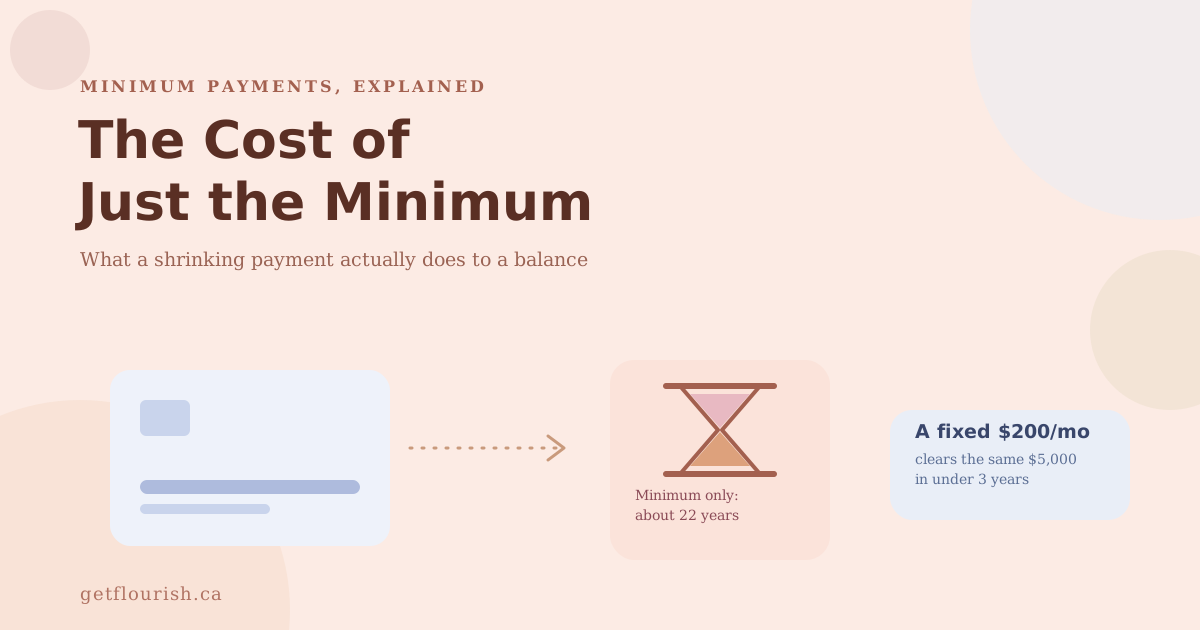
| Fixed $200 a month | 2 years, 10 months (34 months) | $1,632 |
The gap between the first two rows is the real lesson. The payment amount barely changes, $150 a month either way, but simply refusing to let it shrink as the balance drops cuts the payoff time from 22 years to about 4 years and the interest bill by more than $4,100. Moving up to $200 a month saves a further $936 in interest and over a year of payments. Paying only the minimum costs nearly $6,700 in interest on a $5,000 debt, more than the original balance itself.
The Bank of Canada has held its policy rate at 2.25% since its September 2, 2026 announcement, with no scheduled change until October 28, so none of these rates are likely to drift down on their own in the meantime (Bank of Canada). Credit card debt nationally reached $134.2 billion in the second quarter of 2026, up from $130.6 billion the quarter before, with 65% of cardholders paying their balance in full each month and the share making only the minimum holding steady at 4% (Equifax Canada, reported August 24, 2026).
How getFlourish Handles This
getFlourish will not tell you what to pay each month, that depends on your own budget. What it shows is the real payoff date and total interest for whatever amount you actually commit, so "just the minimum for now" stops being an invisible default and becomes a number you can see and change.
Run your own balance and rate, not the example above, on the free debt payoff calculator. If you are carrying more than one balance, Debt Snowball vs Avalanche covers which order to pay them down in, and if the minimum keeps winning because money is tight before each payday arrives, our guide on running out of money before payday covers the timing problem underneath that.
Frequently Asked Questions
How long does it take to pay off a credit card paying only the minimum? On a $5,000 balance at a typical Canadian card rate, paying only the minimum can take around 22 years, because the payment shrinks every month along with the balance. Your card statement is required to show your own estimate for your actual balance and rate.
Is paying the minimum payment on a credit card bad? It is not harmful for a single month, but treating it as your ongoing plan is expensive. The minimum is set to keep your account in good standing, not to pay off your debt in a reasonable time, and the interest cost over years can exceed the original balance.
How is the minimum payment on a Canadian credit card calculated? Most issuers outside Quebec use 2% to 3% of your current balance or $10, whichever is higher, plus interest and fees. Quebec law sets a higher floor of at least 5% of the balance. Check your own cardholder agreement for the exact formula your issuer uses.
Does paying more than the minimum actually make a big difference? Yes. On a $5,000 balance, keeping your payment at the same dollar amount instead of letting it shrink with the balance can cut roughly 18 years off the payoff time and save thousands in interest, without needing a dramatically larger payment.
Why does my minimum payment keep getting smaller? Because it is calculated as a percentage of your current balance, not your original one. As you pay the balance down, the required minimum drops with it, which is the main reason minimum-only payoff timelines stretch out for decades instead of years.